
It is 8:15 AM on a chilly Tuesday morning, and you are standing by the front door with your car keys in your hand. Your seven-year-old is flatly refusing to put on a winter coat, declaring that it feels “too bulky” and that they do not need it. You look outside at the frost on the grass. Your immediate instinct might be to enter a fierce debate, yell about the freezing weather, or issue a stern threat: “If you don’t put this coat on right now, you are grounded from screens this weekend!”
You feel your pulse rising as the countdown to the school bell ticks away. In these high-stress parenting intersections, it is incredibly easy to turn a simple clothing choice into a bitter power struggle. We often feel that if our children do not experience an immediate penalty for their resistance, they will never learn responsibility.
But what if you didn’t have to yell, threaten, or invent an unrelated punishment? What if you could step back and let the environment itself do the teaching?
Positive parenting isn’t about permissive compliance where rules don’t exist, nor is it about harsh control. Instead, it relies on real-world outcomes to build internal responsibility. By shifting away from arbitrary punishments and mastering the strategic use of natural and logical consequences, you can transform daily behavioral battles into valuable life lessons while keeping your relationship with your child completely intact.
Quick Answer: The Core Difference
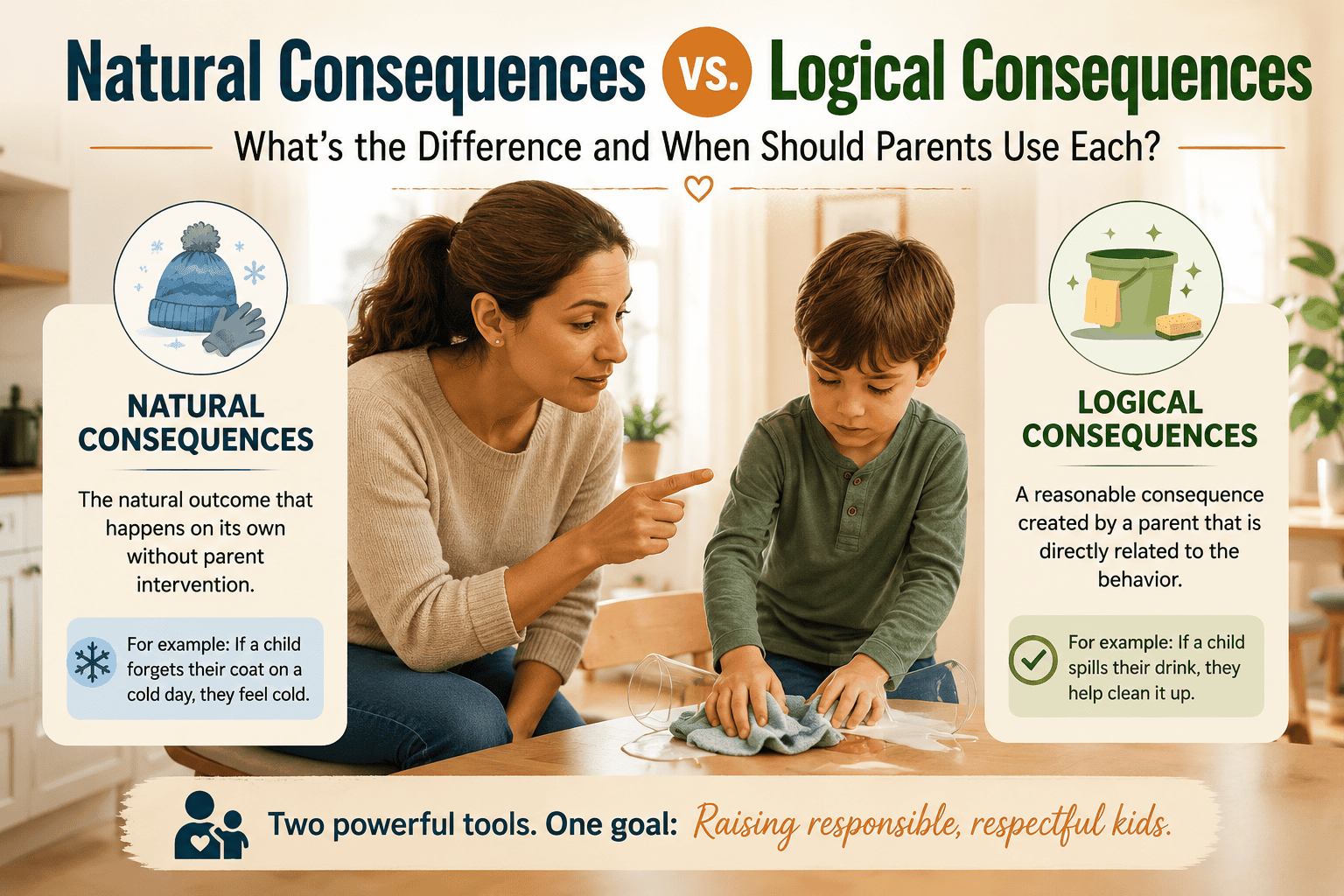
Natural consequences are the automatic, unguided outcomes that happen completely on their own without any parental intervention or discussion. For example, if a child refuses to wear a coat on a cold day, the natural consequence is that they feel cold.
Logical consequences are structured outcomes intentionally created by a parent when a natural outcome is unsafe, unavailable, or harmful to others. These outcomes must be directly related, respectful, and reasonable to the situation. For example, if a child deliberately colors on the living room wall, the logical consequence is that they temporarily lose access to the crayons and help clean the wall.
What Are Natural Consequences?
Definition
A natural consequence is any outcome that flows organically from a child’s choice or behavior without an adult stepping in to manage, modify, or engineer the situation. It is the physical world functioning as the teacher.
Everyday Examples
- The Left Toy: A child leaves their favorite action figure out on the lawn overnight despite a reminder, and the toy gets ruined by the automatic lawn sprinklers.
- The Skipped Meal: A child refuses to eat their dinner because they would rather play. The natural consequence is that they experience a normal sensation of hunger before breakfast.
- The Rushed Work: A school-age child rushes through their homework pages to watch television and produces unreadable handwriting. The natural consequence is that their teacher requires them to erase it and rewrite it during recess.
Benefits
Natural consequences are highly effective because they remove you from the role of the authoritarian “bad guy.” The child cannot blame you for the outcome; they are faced directly with the reality of their own choices. This builds a deep, internal understanding of cause and effect, encouraging genuine internal motivation rather than compliance based on fear.
Limitations & When They Are Inappropriate
While powerful, natural consequences have hard boundaries. Your child might protest at first, but that’s completely normal. However, you must never step back and allow a natural consequence to unfold if it meets any of the following criteria:
- It is Unsafe: Allowing a toddler to run into a busy street to learn that cars are hard is a severe safety failure.
- The Outcome is Too Distant: A seven-year-old cannot conceptualize that failing to brush their teeth tonight leads to a painful cavity six months from now.
- It Harms Others: Allowing a child to throw hard blocks at a sibling to see what happens violates your primary job to protect everyone in the home.
Key Takeaway: Natural consequences are excellent teachers, but only when the lesson is completely safe, immediate, and harmless to others.
What Are Logical Consequences?
Definition
A logical consequence is an intervention engineered by a parent when a natural consequence is unsafe, impractical, or non-existent. To be an effective positive discipline tool rather than a hidden punishment, a logical consequence must satisfy the 3 Rs: it must be Related to the behavior, Respectful in delivery, and Reasonable in scale.
Everyday Examples
- The Thrown Toy: A child repeatedly hurls a plastic truck against the hardwood floor. The logical consequence is that the truck is placed on a high shelf for the rest of the day because toys are for safe play.
- The Spilled Liquid: A child deliberately tips over their cup of milk to watch it run across the table. The logical consequence is that the parent hands them a damp cloth, and they work together to clean up the mess.
- The Screen Violation: A child uses a tablet past the agreed-upon family boundary timer. The logical consequence is that tablet privileges are paused for the following day because they showed they need a break to practice time boundaries.
Benefits
Logical consequences provide an immediate, clear relationship between the uncooperative behavior and the outcome. They preserve the child’s dignity because they are delivered with emotional calm rather than anger, focusing entirely on teaching a better choice for the next time.
Limitations & Critical Boundaries
The greatest challenge of logical consequences is that they require high parental self-regulation. Don’t worry if it doesn’t work perfectly the first time; many parents find this part challenging. If you deliver a logical consequence with a harsh voice, a sarcastic comment, or an excessive timeline, the child’s brain logs the interaction as a hostile punishment.
The moment a child feels shamed, their prefrontal cortex goes offline, and they stop focusing on their mistake, focusing instead on your anger.
Natural vs. Logical Consequences: The Strategic Matrix
To help you choose the right tool during a busy day, this structural index details how these two positive discipline approaches operate side by side:
| Feature / Dimension | Natural Consequences | Logical Consequences |
| Primary Definition | Organic real-world outcomes without any adult interference. | Structured parental interventions directly linked to the behavior. |
| Who Dictates the Outcome? | The natural environment or physical world. | The parent or primary caregiver. |
| Core Learning Opportunity | Direct cause-and-effect relationship with reality. | Responsibility, repair, and social boundaries. |
| Parental Involvement | Zero intervention; offering quiet empathy after the fact. | Active setup, clear communication, and steady enforcement. |
| Safety Considerations | Only usable when the outcome is completely safe. | Used explicitly to maintain absolute physical safety. |
| Best Situations | Weather choices, forgotten items, or minor personal care. | Property damage, boundary violations, or interpersonal conflict. |
| Core Advantage | Eliminates power struggles; parent remains a supportive ally. | Highly flexible; can be used in almost any environment safely. |
| Core Disadvantage | Cannot be used in dangerous or immediate safety situations. | Easily slides into punishment if parent is angry. |
Are Consequences the Same as Punishment?
This is a question many parents ask themselves when trying to implement positive discipline: “Am I actually practicing positive parenting, or am I just using nicer words to disguise a traditional punishment?”
The answer doesn’t lie in what you are doing, but in how you are doing it and why. Traditional punishment is designed to inflict emotional or physical discomfort to make a child pay for their error. A consequence is designed to guide a child’s understanding of real-world relationships.
Let’s look at a clear scenario to see how this difference plays out in real life:
- The Scenario: Your nine-year-old gets frustrated with a video game and kicks the bedroom drywall, leaving a noticeable black scuff mark.
- The Traditional Punishment Response: You scream at them, take away their video game console for an entire month, and ban them from going to a friend’s birthday party this weekend.
- Why it fails: The birthday party has zero relationship to the scuff mark on the wall. The extreme timeline causes the child to swim in resentment toward you, completely missing the lesson about treating property with respect.
- The Positive Consequence Response: You take a slow breath to regulate your own nervous system. You state calmly: “The wall was kicked, so it needs to be repaired. I will help you get the cleaning sponge from the kitchen, and we will scrub this mark off together before dinner.”
- Why it succeeds: The outcome is directly related to the wall. It preserves their dignity, involves them in the active repair of their environment, and teaches them that their actions have immediate, real-world consequences they are capable of fixing.
Key Takeaway: Punishment focuses on suffering; consequences focus on accountability and learning.
When Should Parents Use Natural Consequences?
Natural consequences are best reserved for situations where the stakes are low, the threat to safety is zero, and the natural outcome is immediate enough for the child to link it to their choice.
Realistic Scenarios
- The Forgotten Homework: Your ten-year-old leaves their science project on the kitchen counter. Instead of rushing to deliver it to the school, you let them experience the natural outcome of telling their teacher it was forgotten.
- The Unraveled Toy: A child refuses to put their toys away in their storage boxes, leaving them spread out on the bedroom floor. A sibling steps on a plastic game piece and breaks it. The loss of the toy is the natural lesson.
When Should Parents Use Logical Consequences?
You should pivot to logical consequences the moment safety is compromised, when a natural consequence would take weeks to appear, or when your child’s actions actively infringe on the rights and comfort of other family members.
Realistic Scenarios
- Safety Boundaries: Your preschooler refuses to hold your hand in a crowded parking lot. Because a natural consequence here is life-threatening, you enforce a logical one: “You are having a hard time staying close, so I am going to carry you to the store entrance to keep your body safe.”
- Interpersonal Issues: A child uses unkind language or throws items at a sibling during play. The logical consequence is a temporary separation: “I cannot let you hurt your brother. You need to take a break in this quiet space until your body feels calm enough to try again.”
Age-Based Examples
Toddlers (Ages 2–3)
Toddlers operate entirely in the immediate, physical present. They cannot process abstract logic or delayed timelines. Consequences must happen within seconds of the behavior to be effective.
- The Situation: A two-year-old deliberately throws their hard plastic cup on the floor from the highchair during lunch.
- What to Say: “Food and cups stay on the tray. When you throw the cup, it means you are done drinking for now. I will put the cup on the counter.”
- The Implementation: Move the cup completely out of reach for a few minutes. Do not yell or lecture. Keep the outcome immediate and physical.
Preschoolers (Ages 3–5)
Preschoolers are developing a foundational understanding of cause and effect, but they still struggle with impulse control. They respond beautifully to collaborative, hands-on repair.
- The Situation: A four-year-old leaves all their puzzle pieces scattered across the playroom floor and runs to the kitchen demanding afternoon snacks.
- What to Say: “I see you are ready for a snack! And our family rule is that we take care of our toys before we move to food. As soon as these puzzle pieces are back in their box, I will open the pantry for you.”
- The Implementation: Stand firm but supportive. Offer to help them get started if they feel overwhelmed, but do not provide the snack until the transition requirement is met.
School-Age Children (Ages 6–12)
Older children can think abstractly and participate directly in the problem-solving process. They crave autonomy and appreciate being treated as capable partners in the household team.
- The Situation: Your ten-year-old leaves their wet swim towel crumpled up in a dark corner of their bedroom floor instead of hanging it up, causing it to smell musty.
- What to Say: “Your wet towel was left on the carpet, so it didn’t dry properly. It needs to be washed before you can use it for the pool tomorrow. You can run a small laundry cycle tonight, and I will show you how to measure the soap.”
- The Implementation: Allow them to manage the practical steps of the solution. This transforms a frustrating moment into an invaluable life skill.
Common Parenting Mistakes
1. Rescuing Too Quickly
It is painful to watch our children experience discomfort, disappointment, or minor failure. Out of deep love, we often step in to fix their mistakes before a natural consequence can happen—such as driving back home to deliver a forgotten item.
- The Alternative: Allow safe, minor disappointments to happen. Experiencing the discomfort of a forgotten item today is exactly how children develop an internal checklist for tomorrow.
2. Adding Sarcasm or the “I Told You So” Lecture
The moment a natural consequence unfolds—like a child slipping on wet grass after you told them to slow down—parents often jump in with an emotional lecture: “See? I told you that would happen! Why do you never listen to me?”
- The Alternative: Let the consequence do the heavy lifting. Your words add zero educational value in this moment; they only build defensiveness. Offer quiet, supportive empathy instead: “Ouch, that was a hard slip. Let’s look at your knee to make sure you’re safe.”
3. Setting Long, Unrealistic Timelines
In a flash of frustration, parents often issue sweeping, massive consequences: “That’s it, you lose your bike for the next three months!” Long timelines quickly lose their educational value. The child loses motivation, and the parent eventually gives in because managing the long restriction becomes too exhausting.
- The Alternative: Keep timelines short, immediate, and impactful. For most children under ten, a consequence that lasts 24 hours or until the next morning is more than enough to teach the lesson.
4. Conflating Logical Consequences with Disguised Shaming
Forcing a child to sit on a designated “timeout chair” or making them write a repetitive sentence fifty times on a notepad is not a logical consequence. These actions focus entirely on isolation and external compliance rather than internal learning.
- The Alternative: Focus the consequence entirely on objective real-world relationships. If they misuse an object, the object goes away. If they create a disruption in an environment, they take a brief break to calm their nervous system before returning to try again.
5. Managing Consequences with Anger Rather Than Calm Certainty
If your voice is loud and your muscles are tense when you deliver a consequence, your child focuses entirely on surviving your anger rather than processing their own choice.
- The Alternative: Take a slow breath to regulate your own system before you speak. Deliver the boundary with the calm, quiet certainty of a sports referee stating a neutral rule.
A Note on the Reality of Parenting
Let’s pause for a moment and acknowledge a hard truth: parenting is incredibly difficult. Nobody responds perfectly every single time, and your baseline mood will fluctuate. If you find yourself yelling or issuing an unrealistic threat because you are exhausted, be gentle with yourself. Progress matters far more than structural perfection. Tomorrow is a completely fresh boundary line to try again.
What to Say Instead
Use this daily translation guide to see how shifting your vocabulary transforms arbitrary threats into respectful, educational boundaries:
| Instead of Saying… (Threat/Punishment) | Try Saying… (Positive Consequence) | The Long-Term Educational Benefit |
| “If you don’t clean up your toys right now, I’m throwing them all in the trash!” | “Toys left on the floor can get stepped on and broken. Any toys left out tonight will go into the closet box until the weekend.” | Focuses on property care rather than parent intimidation. |
| “Stop slamming that door or you’re grounded!” | “Doors are for closing quietly to keep our home peaceful. If you need to release big energy, you can stomp your feet on the rug.” | Validates the emotional energy while providing a safe behavior alternative. |
| “You spilled your juice everywhere because you weren’t paying attention! Go to your room!” | “Oops, the juice spilled. Spills need to be cleaned up. I’ll grab the sponge, and we can wipe the table together.” | Focuses entirely on active environmental repair rather than isolation or shame. |
| “Since you can’t get along, no television for the rest of the week!” | “It looks like your bodies are struggling to share this game safely right now. We will put the game away for an hour and try again when everyone feels calm.” | Teaches that access to a shared resource is tied directly to cooperative safety. |
SAFE Decision Method (Original LLP Framework)
When a behavioral storm hits in the middle of a busy afternoon, it can be hard to think clearly. To help you evaluate whether a consequence is appropriate or if it has crossed the line into punishment, use this original LittleLearnerParent mental framework: The SAFE Decision Method.
- S — Safe: Is the outcome completely free of physical or emotional danger?
- A — Appropriate: Does it match the child’s exact age and developmental level?
- F — Fair: Is the scale reasonable, delivered without any personal anger or shame?
- E — Educational: Does it teach the child what to do the next time?
S — Safe
First and always, assess physical and emotional safety. If a natural outcome could hurt your child’s body or cause severe emotional distress, discard it immediately. Safety is your non-negotiable boundary; when natural consequences fail the safety check, you must pivot to a logical consequence.
A — Appropriate
The consequence must align with your child’s developmental capabilities. Expecting a three-year-old to clean up a massive, complex spill completely on their own is inappropriate; they need your close physical collaboration. Match the expectation to what their brain can actually handle.
F — Fair
Check your personal emotional baseline. Are you setting a limit to teach a lesson, or are you acting out of a desire to make them suffer because you are frustrated? A fair consequence is delivered with a calm, steady voice and fits the scale of the behavior without dragging out for weeks.
E — Educational
This is the ultimate test of positive parenting. A consequence must answer the question: “What is my child learning from this outcome?” If the outcome only teaches them that you are powerful and scary when you get angry, it is not educational. It must teach them how to navigate the choice better tomorrow.
10 Practical Tips
- Check Safety First: Always run every situation through the SAFE method before allowing a natural consequence to unfold.
- State Rules Early: Deliver your expectations in a calm voice before your child enters a new environment, not during a crisis.
- Ensure Direct Association: Always verify that your logical consequence is explicitly linked to the behavior (e.g., markers go away if they are used on walls).
- Drop Your Volume: Speak in a deliberate whisper when delivering a boundary to avoid triggering a fight-or-flight response.
- Separate the Child from the Action: Ensure your language frames the behavior as the issue, never your child’s character.
- Offer Two Valid Choices: Guide cooperation by letting them choose between two pre-approved options that hold your boundary.
- Keep Timelines Manageable: Keep the restriction brief so your child has a quick opportunity to return to the environment and try again.
- Enforce with Calm Consistency: Hold the line with steady certainty without entering a long debate or negotiation.
- Model Immediate Emotional Repair: If you lose your temper, apologize cleanly within twenty minutes to show how to handle errors safely.
- Focus Heavily on Progress: Actively notice and validate their small steps toward cooperation, rather than demanding absolute perfection.
Frequently Asked Questions
What if my child completely ignores a logical consequence?
If a child ignores a consequence or refuses to comply, it is usually a clear sign that they are emotionally overwhelmed. Do not enter a power struggle. Drop down to their physical eye level, keep your voice completely calm, and focus on helping them settle their nervous system first before re-introducing the boundary requirement.
Is positive parenting permissive if you don’t use punishments?
No, it is not. Permissive parenting involves removing boundaries, avoiding rules, and rescuing children from every minor discomfort. Positive parenting requires high structure, clear behavioral expectations, and firm limits, held with absolute empathy and respect for the child’s emotional world.
How do you handle natural consequences with toddlers who don’t talk yet?
Non-verbal toddlers learn primarily through physical cause and effect. Keep your interventions immediate, simple, and visual. If they drop a toy deliberately, the toy stays on the floor out of reach for a brief window so their brain can cleanly connect the drop with the loss of the item.
What should I do if a natural consequence doesn’t bother my child?
If a child genuinely doesn’t mind a natural outcome—such as walking out into a light drizzle without an umbrella—let it go completely. If they are safe and comfortable with the result, it is not a battle worth fighting. Save your parental energy for boundaries that impact safety and respect.
How long should a logical consequence typically last?
For toddlers and preschoolers, a few minutes or until the next routine transition is plenty. For school-age children, a consequence should rarely extend past 24 hours. Long, extended restrictions cause children to lose focus on the original mistake and drown in resentment toward the parent.
Can you use these approaches in public places like supermarkets?
Absolutely. If a child mishandles an item or creates a safety hazard in a store, the logical consequence is that they hold your hand or sit safely in the shopping cart until the trip is finished. Deliver the limit with absolute calm, ignoring any outside judgment from onlookers.
What is the biggest difference between a consequence and a bribe?
A bribe is a material transaction offered during a behavioral breakdown to stop a tantrum (e.g., “If you stop crying, I’ll buy you a toy”). A consequence is a predictable, structured outcome delivered after an independent choice to teach accountability.
How can I stop myself from getting angry when a boundary is crossed?
The moment you feel your chest tighten, stop completely. Take a slow, deep breath into your stomach before you utter a single word. Regulating your own nervous system is what allows you to lead with calm authority.
Conclusion
At the end of the day, using natural and logical consequences isn’t about setting up a flawless system of rules. It is about shifting your mindset away from controlling behavior in the short term and moving toward building real-world wisdom for the long haul.
Your child will make mistakes, test boundaries, and push past limits—that is exactly how their brains are designed to learn. By stepping back to let safe natural outcomes teach, and stepping in with calm, related logical consequences when safety is at risk, you stop functioning as an adversary and become a trustworthy guide. Take a deep breath, embrace the messy process, and focus on the relationship first.
The 7-Day Consequence System Challenge
Are you ready to stop managing behavioral crises with threats and transition your home toward independent accountability this week?┌───────────────────────────────────────────────────────────────────
│ THE 7-DAY CONSEQUENCE SYSTEM CHALLENGE
├───────────────────────────────────────────────────────────────────
│ COMMIT TO JUST TWO REGULATORY HABITS FOR THE NEXT WEEK:
│
│ 1. Apply the SAFE method to allow three minor natural outcomes.
│ 2. Deliver every boundary using a calm, regulated tone of voice.
└───────────────────────────────────────────────────────────────────
🏃♂️ The Tiny Win Challenge
Pick one repetitive daily friction point in your home—such as a child refusing to put away their shoes or struggling to pack their school backpack. Sit down for five minutes today during a query and outline one clear, logical consequence that satisfies the 3 Rs. Share this rule with your child calmly before the routine starts tomorrow so everyone knows exactly what to expect.