
It is 5:30 PM on a frantic Monday, and your living room has completely succumbed to sensory overload. The baseboards are lined with plastic building blocks, an open box of crackers has been accidentally stepped on, and your four-year-old is face-down on the rug, screaming because it is time to turn off the television. Your heart rate rises. You want to practice a mindful style of modern parenting, but in this specific window of time, the theories you saved on social media can feel incredibly distant.
One voice in your head reminds you to remain completely calm, co-regulate, and sit with your child’s big feelings until the storm passes. Another voice worries that if you do not take immediate, structured action, you might be accidentally validating a lack of respect or permissive behavior.
If you find yourself caught between these internal scripts, you are experiencing a very common modern parenting identity crisis. Parents are no longer choosing simply between traditional, punitive methods and permissive structure. Instead, the debate often focuses on a comparison of two prominent, relationship-focused frameworks: Gentle Parenting vs. Positive Parenting.
While both methods prioritize a deep parent-child connection and reject physical or emotional punishment, they operate through distinct tones, histories, and everyday techniques. Understanding these nuances is exactly how you stop feeling like a fragmented observer in your own home and start leading your family with absolute clarity.
Quick Answer: The Core Distinction
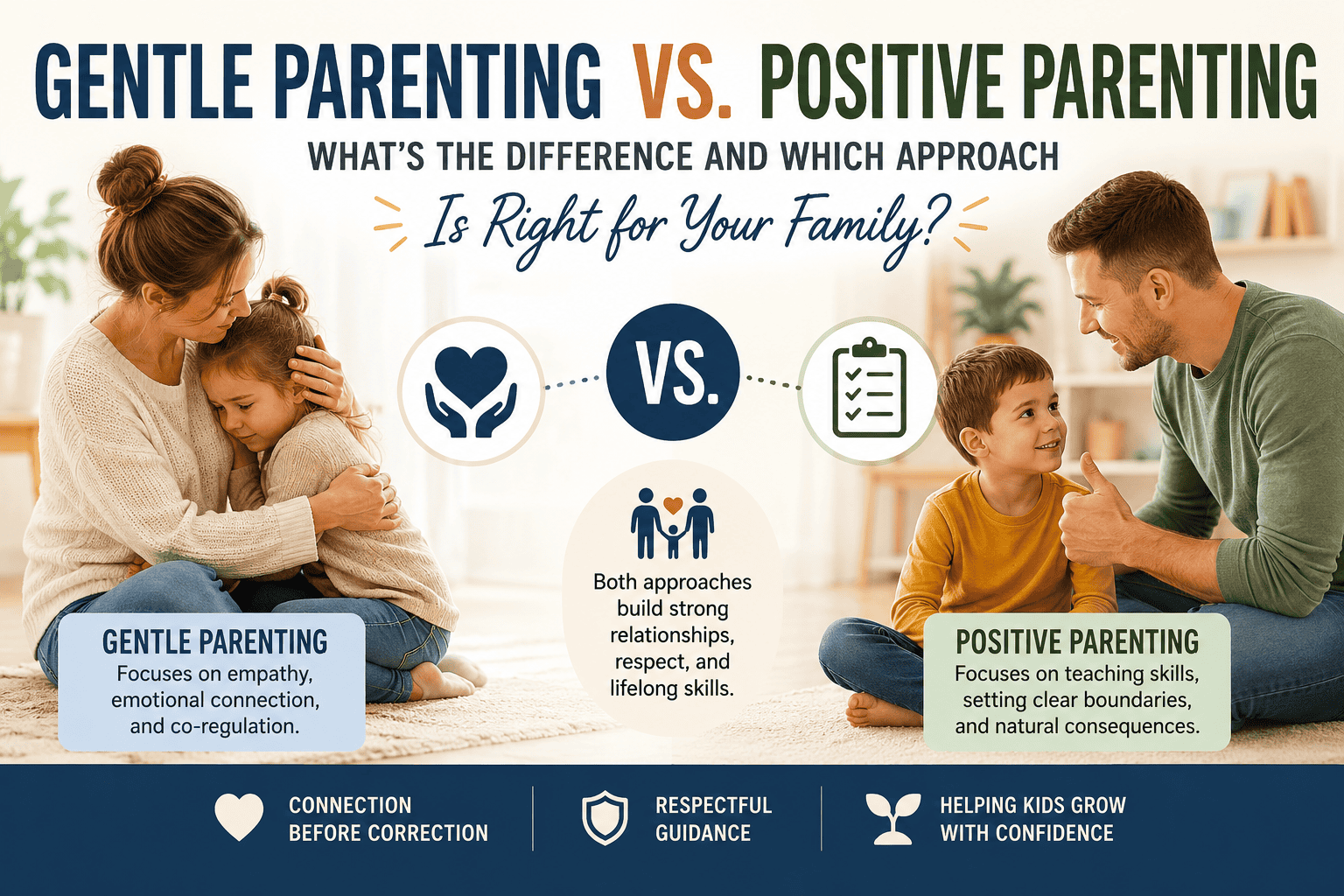
Gentle parenting and positive parenting are both non-punitive, relationship-centered approaches, but they often differ in their execution and daily focus.
- Gentle parenting focuses heavily on the internal state of both parent and child, using deep empathy, co-regulation, and emotional processing to navigate behavioral struggles. It centers on understanding the child’s underlying feelings.
- Positive parenting draws on several evidence-informed traditions—including developmental psychology, social learning theory, Adlerian principles, attachment research, and behavioral science. It emphasizes clear, proactive instruction, structural boundaries, and natural or logical consequences to teach actionable skills and reinforce cooperative behavior.
💡 Key Takeaway
Gentle parenting and positive parenting share a core belief that connection drives cooperation. The main difference lies in how each approach balances immediate emotional coaching with structured behavioral guidance.
What Is Gentle Parenting?
Definition
Gentle parenting is an intuitive, relationship-focused style based on the principles of empathy, respect, and deep emotional understanding. It emphasizes partnership over power. Many advocates of gentle parenting place less emphasis on sticker charts and external reward systems, although practices vary widely among families and professionals.
Core Principles
- Empathy: The parent actively attempts to see every behavioral disruption through the emotional perspective of the child.
- Respect: Treating a child’s personal autonomy and emotions with the same dignity you would offer an adult.
- Co-Regulation: The belief that a child cannot regulate their own nervous system unless an adult first models a calm, steady physical presence.
Common Techniques
- Sitting Through the Storm: Rather than trying to immediately fix a tantrum, the parent sits quietly near the child, offering presence without demanding compliance.
- Reflecting Feelings: Explicitly naming the emotional wave: “You are feeling incredibly sad that the show is over. I am right here while you are sad.”
What Is Positive Parenting?
Definition
Positive parenting is a structured, evidence-informed framework designed to encourage cooperative behavior while building a child’s internal capability and confidence. Evidence-informed parenting programs often emphasize that children naturally repeat actions that receive meaningful, descriptive attention.
Core Principles
- Connection Before Correction: Prioritizing emotional safety and trust as a prerequisite for behavioral instruction.
- Proactive Teaching: Intentionally teaching expected behavior during quiet, calm windows of time rather than only during a crisis.
- Encouraging Autonomy: Using natural and logical consequences to help children understand real-world cause and effect.
Common Techniques
- Positive Reinforcement: Using descriptive, non-evaluative language to anchor helpful actions: “I noticed you slid your shoes into the basket without a reminder.”
- The 3 Rs of Consequences: Implementing outcomes that are explicitly Related, Respectful, and Reasonable to the choice made.
Shared Foundations
Before exploring the strategic differences, it is vital to recognize why these two approaches are often used interchangeably. They share a deep ideological core that sets them far apart from traditional, fear-based parenting techniques:
- Rejection of Punitive Discipline: Current evidence indicates that physical punishment, threats, and isolation-based shaming can be harmful to long-term child development. Both frameworks explicitly reject these methods.
- Behavior and Communication: Both styles operate on the understanding that while challenging behavior can be a way for a child to communicate an unmet need or a skill deficit, it can also stem from a variety of other factors, including physical fatigue, overstimulation, developmental leaps, or environmental stress.
- Focus on the Adult’s Behavior: Both frameworks place the primary responsibility for behavior management on the parent’s ability to self-regulate before addressing the child.
Key Differences: Gentle Parenting vs. Positive Parenting
While the baseline intent is identical, the operational differences manifest clearly in day-to-day household interactions.
1. Psychological Origins
Gentle parenting grew largely as a grassroots movement driven by modern attachment theory and independent parenting authors. Positive parenting is directly descended from the clinical and educational frameworks of Alfred Adler and Rudolf Dreikurs, heavily supported by decades of structured cognitive-behavioral research and social learning theory.
2. Behavioral Focus vs. Emotional Focus
Gentle parenting focuses primarily on the child’s internal emotional state. Behavior is viewed frequently as a secondary reflection of emotional wellness. Positive parenting focuses heavily on actionable behavior and skill building, using connection as the tool to teach cooperative social habits.
3. The Approach to Structuring Limits
When a boundary is crossed, a gentle parent focuses first on validating the resulting disappointment, sometimes leaving the timeline of compliance open to allow the child to process the feeling. A positive parent establishes a firm, predictable boundary immediately and uses structured choices or natural outcomes to move through the block safely.
Gentle Parenting vs. Positive Parenting Comparison Matrix
This reference index details how both styles can diverge and interlock across daily structural features:
| Strategic Dimension | Gentle Parenting Style | Positive Parenting Style |
| Primary Core Focus | Emotional regulation and internal processing. | Proactive skill building and cooperation. |
| Historical Origin | Attachment theory and grassroots modern authors. | Cognitive-behavioral psychology and Adlerian models. |
| Role of the Caregiver | An empathetic partner and co-regulator. | A clear leader, teacher, and supportive coach. |
| Discipline Execution | Spatial presence, empathy, and allowing emotional release. | Clear limits, choices, and structured outcomes. |
| Handling Tantrums | Sitting quietly through the storm with validation. | De-escalating safely, then teaching alternate choices. |
| Motivators Used | Intrinsic emotional security and parent connection. | Descriptive encouragement and natural consequences. |
| Boundary Style | Fluid, highly responsive to immediate feelings. | Clear, highly predictable, firm but empathetic. |
| Core Vulnerability | Can slide into permissive patterns if limits fade. | Can feel overly transactional if connection is skipped. |
Gentle Parenting vs. Positive Parenting by Age
Parenting needs change dynamically as children grow. Because neither approach has a single, universally accepted definition, it helps to look at how these overlapping philosophies manifest across different developmental stages.
Toddlers (Ages 2–3 Years)
At this stage, young children are still developing the skills needed for planning, impulse control, and emotional regulation. They learn primarily through immediate physical feedback and simple language.
- Gentle Parenting Approach: Focuses heavily on physical co-regulation. When a toddler bites a sibling out of frustration, a gentle parent might sit with the biting child, wrap them in a calm embrace, and focus on soothing their hyper-aroused nervous system before speaking.
- Positive Parenting Approach: Emphasizes immediate behavioral redirection and environment design. The positive parent will calmly separate the children immediately, state the rule positively (“Teeth are for chewing food”), and pivot the toddler to a safe teething toy or a completely different physical activity.
Preschoolers (Ages 3–5 Years)
Preschoolers understand basic cause-and-effect relationships but are easily overwhelmed by intense emotions. They thrive on predictable routines.
- Gentle Parenting Approach: Prioritizes deep emotional naming and processing. If a four-year-old throws a tantrum because playtime is over, the parent allows the emotional release to happen without rushing them, saying, “You are furious that we have to clean up. It is safe to cry it out.”
- Positive Parenting Approach: Utilizes structured choice and environmental consistency to guide behavior. The parent avoids the power struggle by offering limited autonomy: “Playtime is done. Would you like to clean up the blocks or the books first? You decide.”
School-Age Children (Ages 6–12 Years)
Older children can think abstractly and participate directly in family problem-solving. They crave autonomy and are deeply sensitive to fairness.
- Gentle Parenting Approach: Focuses on collaborative discussion and mapping out the child’s perspective. If an eight-year-old refuses to do their chores, the parent sits down to explore their feelings about their workload, validating their exhaustion after a long school day.
- Positive Parenting Approach: Relies on pre-established family systems and logical consequences. The parent references the house routine: “Our family agreement is that homework and chores are completed before screen time. Once your room is tidy, the tablet password is yours.”
Which Approach Is Better?
Many parenting experts recommend looking past labels entirely. Current evidence suggests that family context, child temperament, and parental consistency matter far more than strictly adhering to a single philosophy.
When Gentle Parenting Shines
Research suggests that high levels of parental empathy are deeply beneficial for highly sensitive children who become easily overwhelmed by perceived authority or rigid structure. It provides immense comfort for children navigating anxiety or temporary emotional vulnerability.
When Positive Parenting Takes the Lead
Evidence-informed parenting programs often show that spirited, strong-willed children thrive when they have clear, predictable structures to feel safe. If your home is prone to chaotic transitions or frequent daily friction, the structured routines and logical consequences of positive parenting provide immediate, reliable safety nets.
Can Parents Combine Both Approaches?
Absolutely. In fact, raising kids in a dynamic household practically requires a hybrid model. Combining the deep, emotional validation of gentle parenting with the clear, structured boundaries of positive parenting creates a resilient system we call Responsive Leadership.
By merging these approaches, you ensure your child feels deeply respected and emotionally safe, while maintaining a predictable environment where behavioral expectations are completely clear.
The CARE Framework: An Integrated LLP Method
To help you blend the best elements of both styles into one repeatable daily workflow, we designed an original framework: The CARE Method.
- C — Connect Before Correcting: Recognize and acknowledge your child’s emotions before addressing behavior. Drop down to their physical eye level and name the feeling to support connection.
- A — Apply Age-Appropriate Expectations: Respond based on your child’s developmental stage rather than expecting adult-level self-control. Young children are still developing the skills needed for planning, impulse control, and emotional regulation.
- R — Respond with Respectful Boundaries: Set clear, calm, and consistent limits while maintaining respect and connection. State the rule positively by describing what to do rather than what not to do.
- E — Encourage Learning: Focus on helping your child understand what happened, what they can learn, and how they can make a better choice next time.
C — Connect Before Correcting
Before you address an unwanted action, check your child’s emotional baseline. Drop down to their physical eye level and name the feeling.
- Practical Example: “I see you are incredibly angry right now because your tower fell over. It is frustrating when hard work breaks.”
- Takeaway: Connection supports emotional safety, making a child more receptive to guidance; correction without connection frequently triggers resistance.
A — Apply Age-Appropriate Expectations
Remind yourself that your child’s brain is still developing the complex wiring needed for emotional regulation.
- Practical Example: Reminding yourself that a tired three-year-old cannot sit quietly through a long, formal restaurant dinner without active engagement or sensory breaks.
- Takeaway: Aligning your expectations with child development eliminates a huge amount of parental frustration.
R — Respond with Respectful Boundaries
This is where positive parenting structure supports gentle empathy.
- Practical Example: “I cannot let you hit. If you are angry, you can stomp your feet on the rug or tell me with your words.”
- Takeaway: Boundaries are not an act of control; they are an act of care that provides safety.
E — Encourage Learning
Once the emotional wave has passed, use the moment to teach.
- Practical Example: Once calm, asking: “When your brother takes your toy next time, what can you say to him instead of using your hands?”
- Takeaway: True discipline is about teaching long-term skills, not enforcing short-term submission.
Real-Life Parenting Scenarios in Action
Let’s look at how the CARE method handles four common everyday household situations that cause routine parental exhaustion.
Scenario 1: The Public Grocery Store Tantrum
- The Situation: Your four-year-old screams on the store floor because you refused to buy a highly processed, colorful cereal box.
- The Permissive Trap: You hand them the cereal box just to stop the public stares and finish shopping in peace.
- The CARE Framework Response:
- Connect: You drop to one knee on the floor: “You are really disappointed that we aren’t buying that cereal today. It looks fun, and it’s hard to hear a no.”
- Apply: You remind yourself that public spaces create sensory overload, making impulse control very difficult for a four-year-old brain.
- Respond: You hold the line calmly: “The answer is no. We are buying the items on our family grocery list today. Would you like to carry the list or help me place the apples in the cart?”
- Encourage: Once you are buckled in the car safely, you review: “It was tough to feel disappointed in the store, but you helped choose the apples. Next time, we can check the list together before we walk inside.”
Scenario 2: Sibling Toy Friction
- The Situation: Your seven-year-old deliberately yanks a toy away from their five-year-old sibling, causing an immediate crying match.
- The Traditional Punishment Trap: You yell at the older child, call them selfish, and ban all electronic devices for a week.
- The CARE Framework Response:
- Connect: You separate the children physically and focus your eye contact on the older child: “You were really wanting to finish your turn, and you felt frustrated that your time was running out.”
- Apply: You recognize that sharing a highly engaging resource requires advanced self-regulation that easily breaks down under fatigue.
- Respond: You deliver a logical consequence calmly: “Grabbing is not safe. Because the toy was yanked, it is going on the high shelf for the next hour until everyone feels calm enough to share.”
- Encourage: Later, you provide a clear script tool: “When you want a turn, what can you say to your brother instead of grabbing? Try using your words.”
Scenario 3: The Refusal to Complete Homework
- The Situation: Your nine-year-old slams their notebook shut, declaring that their assignment is “stupid” and that they refuse to complete it.
- The Authoritarian Trap: “You will sit there until midnight if you have to, and if you get a zero, you lose your weekend privileges!”
- The CARE Framework Response:
- Connect: You sit at the table next to them: “This passage feels incredibly heavy today, and you are feeling completely overwhelmed by these questions.”
- Apply: You recognize that academic resistance is almost always a mask for a deep fear of failure or physical fatigue.
- Respond: You set a collaborative timeline boundary: “We need to complete this assignment today. Let’s set our timer for just five minutes of reading, and then we will take a movement break together.”
- Encourage: “Look at how you tackled that first sentence after taking a break. You figured out that tricky word by breaking it into pieces. That shows real focus.”
Scenario 4: Bedtime Stall Tactics
- The Situation: Your six-year-old repeatedly walks out of their bedroom demanding an extra glass of water, another hug, or a specific answer to a random question.
- The Angry Overdrive Trap: You escalate to shouting: “Get back in that bed right now or I am locking the door!”
- The CARE Framework Response:
- Connect: You walk them back to their room calmly, place a hand on their shoulder, and speak in a whisper: “Your body is having a hard time settling down tonight, and you are wishing you could stay up with the grownups.”
- Apply: You recognize that bedtime separation triggers normal childhood dependency and anxiety.
- Respond: You implement a structured tool: “Here is your bedtime pass for tonight. It is good for exactly one quick check. Once it is used, your door stays cracked open, and my body stays in the hallway.”
- Encourage: The next morning, you call out the win: “You used your bedtime pass just once last night and stayed in your bed. Look how rested and energized your body feels to start the day!”
“What to Say Instead” Conversation Scripts
Review this translation matrix to see how to pivot away from reactive scripts and move toward an integrated, supportive voice:
| When You Feel Like Shouting… (Reactive Control) | Try Saying This Instead… (The CARE Voice) | The Long-Term Behavioral Benefit |
| “Stop crying over absolutely nothing, you’re fine!” | “You are feeling incredibly sad about this change. It is okay to cry. I am right here with you.” | Teaches emotional literacy and locks in deep relationship safety. |
| “If you don’t clean this room up, I’m throwing every toy away!” | “Toys left on the floor can get broken. Once the building blocks are back in their bin, we can go outside.” | Establishes a logical sequence while protecting property care values. |
| “Why can’t you just behave like your sister?” | “You are having a really hard time keeping your body still right now. Let’s walk to the kitchen and get some water together.” | Prevents toxic identity comparison while offering immediate sensory redirection. |
| “Because you lied to me, you are grounded from everything!” | “It takes real courage to tell the truth. We need to work together to solve this mistake safely.” | Destroys the fear of punishment so children feel safe admitting mistakes. |
The LLP Parenting Style Decision Tree
Use this diagnostic sequence to evaluate which approach fits a specific parenting challenge in your home:
Plaintext
[ START: Behavioral Disruption Occurs ]
│
▼
Is your child experiencing an intense meltdown?
├──► YES: [ GENTLE PARENTING CO-REGULATION ]
│ Focus on calm physical presence, validation,
│ and emotional safety.
│
└──► NO: Is your child breaking a clear safety or household rule?
├──► YES: [ POSITIVE PARENTING STRUCTURE ]
│ Enforce limits via pre-approved choices
│ or directly related logical consequences.
│
└──► NO: [ THE ENVIRONMENT PIVOT ]
Step back safely and allow natural, real-world
outcomes to provide the life lesson.
Myths vs. Facts
Let’s dismantle the common misconceptions that circulate online regarding both of these modern discipline models:
- Myth: Gentle parenting creates soft children who cannot handle the real world.
- Fact: Validating emotions does not mean softening reality. Gentle parenting builds immense emotional resilience by teaching children how to process internal distress safely.
- Myth: Positive parenting relies on constant praise and rewards, creating a dependency on external approval.
- Fact: True positive parenting rejects empty, general praise like “good boy.” It relies on objective, descriptive encouragement that builds internal motivation.
- Myth: Both of these styles are just permissive parenting with nicer branding.
- Fact: Permissive parenting lacks boundaries. Both gentle and positive parenting require high, firm standards of respect and safety, executed with deep empathy.
5 Common Mistakes to Sidestep Today
1. Over-Validating Until the Limit Melts Away
It is a common trap to get so caught up in validating a child’s sadness that you accidentally abandon the boundary altogether. If your child throws a tantrum about putting away a screen and you extend screen time by twenty minutes to comfort them, you have moved from empathy into permissive parenting.
- The Pivot: Hold the boundary while honoring the feeling: “I know you are angry that the show is over. And it is still time to turn the device off.”
2. Mimicking a Robotic Voice
Children have an extraordinary capacity to detect insincerity. If you read a script from a book using a flat, detached voice while your internal stress is peaking, your child will sense the mismatch and push harder.
- The Pivot: Stay human. Speak naturally, use everyday language, and allow your real personality to shine through your boundaries.
3. Explaining Complex Logic in the Middle of a Crisis
Children may find it harder to regulate emotions, think clearly, or solve problems when they are overwhelmed. Attempting to deliver a long, intellectual lecture on why they need to cooperate is an absolute waste of parental breath.
- The Pivot: Prioritize physical safety and silence first. Save your teaching and reflection questions for the evening when everyone is calm.
4. Taking the Behavioral Breakdown Personally
When a child screams or slams a door, they are not executing a calculated strike against your authority. They are simply displaying a loud, unrefined release of internal overwhelm.
- The Pivot: View the disruption as a call for help rather than a personal insult. Your emotional distance is what keeps the boundary stable.
5. Demanding Constant Parental Perfection
Attempting to become a non-stop, perfectly calm parenting archetype is a fast track to profound burnout. You will lose your temper, you will issue an arbitrary threat, and you will make mistakes.
- The Pivot: Embrace steady progress over perfection. Use your personal errors as a direct runway to model genuine relationship repair in front of your children.
A Note on the Reality of Parenting
Let’s pause for a moment and acknowledge a hard truth: parenting is incredibly difficult. Nobody responds perfectly every single time, and your baseline mood will fluctuate. If you find yourself yelling or issuing an unrealistic threat because you are shattered, be gentle with yourself. Progress matters far more than structural perfection. Tomorrow is a completely fresh boundary line to try again.
Frequently Asked Questions
What is the biggest difference between gentle and positive parenting?
Gentle parenting focuses primarily on navigating the child’s internal emotional world through empathy and co-regulation. Positive parenting draws on multi-disciplinary behavioral and attachment research to emphasize proactive behavior modification, clear structure, routines, and natural or logical consequences.
Which parenting style is backed by more scientific evidence?
Positive parenting is supported by a large body of educational frameworks, developmental research, behavioral studies, and longitudinal trials. Gentle parenting techniques find strong support in modern neuroscience insights, relational psychology, and attachment theory.
How do these non-punitive approaches handle discipline?
Neither style uses physical punishment, threats, or isolation-based shaming. Instead, they use proactive communication, clear visual routines, pre-approved choices, and natural or logical consequences that teach accountability rather than fear.
Can gentle parenting work for high-energy, strong-willed children?
Yes, but it must be paired with firm, reliable boundaries. Spirited children can interpret pure emotional validation without clear, immovable limits as unstable chaos, causing them to push harder to find where the true wall is.
What should I do if my co-parent prefers a traditional, punitive approach?
Do not turn your adult relationship into an adversarial battleground in front of the kids. Sit down privately during a quiet evening and find common ground on just one small boundary. Focus on demonstrating the effectiveness of the CARE method through your own daily actions.
Does positive parenting create a dependency on rewards or charts?
No. True positive parenting explicitly avoids material bribes, physical prizes, or empty praise-seeking metrics. It utilizes specific, descriptive encouragement to help children internalize the natural satisfaction of being a helpful member of the household team.
How do I handle a public tantrum without sliding into permissive parenting?
Acknowledge your child’s intense disappointment calmly, ignore any perceived judgment from onlookers, and hold your boundary with absolute certainty. If safety is at risk, physically carry them to a quiet space until their nervous system resets.
What if my child completely ignores my calm instructions?
If a child ignores your voice, stop repeating yourself from across the room. Walk over, gently place a hand on their arm, drop down to their physical eye level, and wait for steady eye contact. State the instruction once clearly, and ask them to repeat it back to verify processing.
Can teachers or daycare centers implement the CARE framework?
Yes, absolutely. The CARE framework functions beautifully in group learning environments. Educators who replace generic praise with descriptive encouragement and maintain consistent, respectful boundaries see massive improvements in student resilience and collaboration.
How long does it take to see real results with these styles?
While connection-focused habits can improve cooperation in days, building deep internal emotional regulation, accountability, and life-long resilience is a non-linear process that takes months of steady consistency.
The Ultimate LittleLearnerParent Weekly Challenge
Are you ready to move past theory and begin practicing responsive leadership in your living room this week?
THE 7-DAY RESPONSIVE LEADER CHALLENGE
COMMIT TO IMPLEMENTING THE CARE PROTOCOL FOR THE NEXT WEEK:
1. Validate the emotion before you issue any behavioral direction.
2. Use positive language to describe the clear rule immediately.
🏃♂️ The Tiny Win Challenge
Pick just one repetitive daily transition that consistently causes friction in your home—such as morning shoe prep or dinner clean-up. Sit down tonight and write out a custom two-sentence script that combines gentle validation with positive structure. Deliver that exact script calmly tomorrow as soon as the transition arrives, and watch how a small shift in language transforms the household dynamic.