
It is 4:30 PM on a crowded Saturday, and you are standing in the middle of a busy supermarket aisle. Your two-year-old has just collapsed into a sprawling, screaming heap on the floor because you said no to a brightly colored candy bar near the checkout counter. Their face is bright red, their fists are drumming against the ground, and their vocal cords are operating at maximum volume.
Suddenly, every eye in the immediate vicinity seems to be pinned directly on you. You can feel the hot prickle of embarrassment climbing up your neck, mixed with a deep wave of physical exhaustion and frustration. Your immediate, automatic internal script urges you to open your mouth and yell over the noise: “Stop this screaming right now, or we are leaving and you are getting absolutely nothing!”
If you have stood in that exact intersection of stress and public visibility, you are in very good company. Many parents have experienced that tightening in their chest when a child’s emotional state switches without warning. It is entirely normal to feel overwhelmed or frustrated in these moments.
However, yelling at a child who is already drowning in an emotional wave is often like pouring fuel on a kitchen fire. It can escalate the stress in the room, cut off communication, and leave everyone involved feeling disconnected.
Learning how to handle tantrums without yelling isn’t about maintaining a state of perpetual, artificial perfection; it is about choosing predictable, steady habits that guide your child back to a state of calm while keeping your boundaries firm and protective. Let’s look at how to replace reactive shouting with evidence-informed, practical leadership.
Quick Answer: How Do You Handle Tantrums Without Yelling?
To handle tantrums without yelling, parents should focus on emotional co-regulation and firm boundary maintenance rather than punishment or reactive screaming. Evidence-informed parenting strategies recommend dropping down to the child’s level, keeping your vocal tone low and steady, and validating their underlying feelings without abandoning your baseline rule.
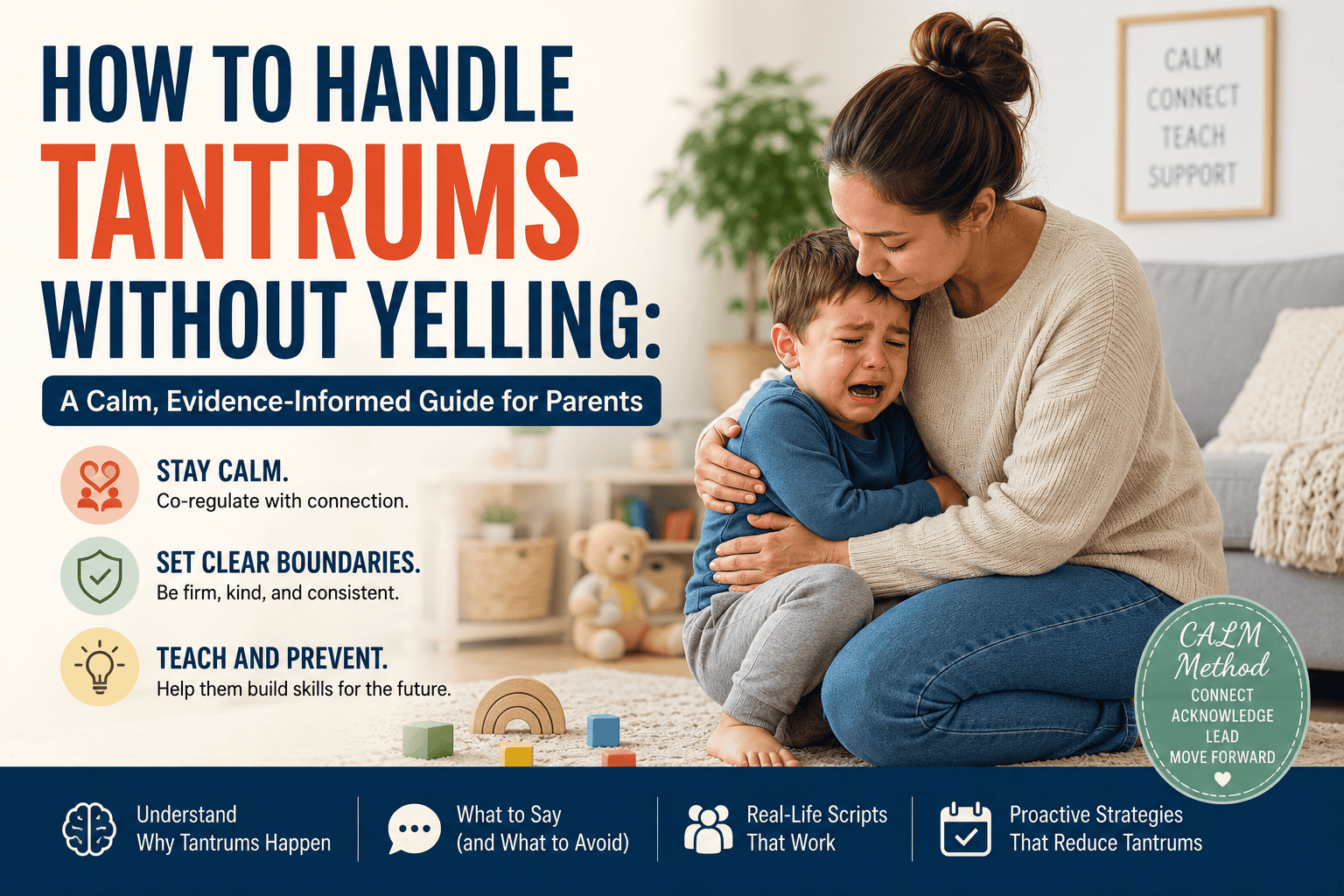
By utilizing the original CALM Method (Connect, Acknowledge, Lead, Move Forward), you provide a predictable framework that supports long-term emotional regulation, teaches cooperation, and reduces the frequency of future challenges.
💡 Quick Takeaway
A child’s tantrum is not necessarily a calculated strike against your personal authority; it is frequently a visible signal that their internal system is temporarily overwhelmed by an emotion or a situation they do not yet have the skills to navigate safely.
What Is a Tantrum?
Understanding Emotional Overwhelm
A tantrum is often an involuntary behavioral explosion that occurs when a young child experiences a surge of intense emotion—such as frustration, anger, disappointment, or fear—that outpaces their current developmental ability to manage or express through language.
When a tantrum hits, the child is rarely acting out of logical choice. They are experiencing a temporary collapse of emotional control.
Developmental Limitations
Young children are still developing the foundational brain pathways required for planning, reasoning, impulse control, and emotional regulation. These skills grow slowly over the first decade of life.
When a child faces a boundary, like a tablet turning off or leaving a park, they may perceive that disappointment as an immediate crisis. Because they lack the inner tools to naturally down-regulate that stress, their body defaults to a physical, emotional release.
Tantrums vs. Intentional Misbehavior
It can be helpful to distinguish a genuine tantrum from intentional behavioral testing, though the boundaries between them can blur:
- A Tantrum is a state of emotional overload. The child has lost control of their expressions, and logic often will not work until they begin to feel calmer and more secure.
- Intentional Misbehavior involves a child who is in relative control of their emotions but is testing a boundary to see if a parent’s rule is solid or fluid.
Many tantrums begin with simple boundary testing or frustration over a goal, but they can quickly cross the line into genuine emotional overwhelm. Because overload and boundary testing can coexist, avoiding rigid either/or classifications helps you respond to the child’s actual needs rather than a label.
Distinguishing Tantrums from Meltdowns
Many parents and caretakers use the terms “tantrum” and “meltdown” interchangeably, but they are not identical. While they can look similar from across a room, their causes and solutions can diverge.
📊 Behavioral Comparison: Tantrum vs. Meltdown
- The Tantrum: Usually triggered by a specific desire, boundary, or frustration—such as wanting a specific toy or resisting a routine transition. It is goal-driven. If the desire is held behind a firm limit, the child may become overwhelmed, but they typically return to a state of calm as they feel supported and understood.
- The Meltdown: An involuntary response to sensory, cognitive, or emotional overload. It happens when a child’s environment delivers more inputs (noise, lights, fatigue, crowds) than their system can process. A meltdown is not goal-driven; the child often continues to struggle even if you hand them the exact item they originally wanted.
Note: The distinction between a tantrum and a meltdown isn’t always clear-cut and depends heavily on immediate family context and a child’s unique biological threshold.
Why Do Children Have Tantrums?
Children do not wake up planning to disrupt our schedules. Most daily behavioral challenges occur due to a predictable mix of developmental factors and physical vulnerabilities:
- Brain Development: Because children are still building structural regulation pathways, they often experience emotions with raw, immediate intensity without an internal filter.
- Communication Limitations: Toddlers understand far more language than they can physically produce. When they cannot find the exact words to explain a complex internal desire, they may resort to physical expression.
- Fatigue and Hunger: A drop in blood sugar or missing an afternoon nap drastically reduces a child’s capacity to tolerate even minor frustrations.
- Overstimulation: Bright lights, loud grocery stores, family gatherings, or back-to-back errands can push a sensitive child past their capacity to cope.
- Routine Transitions: Moving away from a highly preferred activity (like playing blocks) to a non-preferred task (like bath time) can feel like a jarring loss of control.
- The Drive for Independence: Preschoolers are discovering that they are separate individuals with their own distinct wills. Frustration often explodes when their fierce desire for autonomy clashes with a parent’s safety rule.
Why Yelling Usually Makes Tantrums Worse
When your child starts screaming, your own body naturally flags the noise as stress. Your heart rate increases, your muscles tighten, and you may feel an urge to match their volume to regain immediate control of the environment.
However, current evidence indicates that yelling at an overwhelmed child creates several long-term discipline issues:
- It Escalates the Stress: Yelling proves to the child that the adult in the room is also out of control. This can heighten their internal panic, extending the duration of the emotional wave.
- It Hinders Learning: Children often find it much harder to learn a new behavioral skill when they are frozen in a state of fear or defensiveness. Yelling causes them to focus on surviving your anger rather than processing their own choice.
- It Models Poor Self-Regulation: Every time we shout during a crisis, we can inadvertently teach our children that yelling is the correct, mature way to respond when life becomes frustrating or overwhelming.
The LittleLearnerParent CALM Method
To help you stay grounded when a tantrum strikes, we designed a signature framework called The CALM Method. This four-step sequence keeps your tone regulated while ensuring your household boundaries remain completely firm.
C — Connect Before Correcting
Before you address an unwanted action, prioritize emotional safety and trust. Drop your body down to their eye level, un-clench your jaw, and adopt a relaxed body posture. If safe, offer a gentle hand on their shoulder or an open, calm space. Your physical stillness provides a safe anchor that invites them to begin to feel calmer and more secure.
A — Acknowledge Feelings
Name the emotion as clearly and simply as you can. Avoid dismissing or minimizing their distress. By saying, “You are really angry that we have to go home,” you teach them emotional literacy and prove that you understand their frustration, even if you aren’t going to alter the rule.
L — Lead with Calm Boundaries
This is where positive parenting structure supports your empathy. State the baseline limit clearly, using positive commands that describe what to do rather than what not to do. Do not enter a long debate, offer an extensive lecture, or try to bargain with an uncalmed child.
M — Move Forward Through Teaching
Once the emotional storm has passed and they become better able to think clearly, listen, and solve problems, pivot to instruction. This is the window where real learning happens. Review what went wrong and provide them with a practical script or choice for the next time they face that specific frustration.
Step-by-Step Tantrum Response Blueprint
The First 30 Seconds: The De-Escalation Pass
- Stop Talking: Close your mouth. An overwhelmed child cannot process verbal logic.
- Breathe Visibly: Take two slow, deep breaths. Let your child see and hear your physical self-regulation.
- Secure the Space: If you are in a dangerous spot (like a parking lot), calmly and safely lift their body and move them to a secure area. If you are at home, clear away any hard toys or sharp objects.
What to Say in the Middle of the Storm
Keep your sentences extremely brief, clear, and steady. Use phrases such as:
- “I am right here with you.”
- “It is okay to feel really disappointed.”
- “I will keep you safe while you are angry.”
- “We will figure this out together when you’re ready.”
What to Avoid Doing
- Do not mock or mimic their crying.
- Do not laugh, use sarcasm, or tell them they are acting like a baby.
- Do not threaten extreme, unrelated punishments that you will inevitably take back later (e.g., “No park for the rest of the year!”).
- Do not give in to their original demand just to buy short-term silence, as this explicitly teaches them that screaming is an effective way to break your rules.
What to Do Afterward: The Repair Window
Once their body stops shaking and their emotional intensity begins to decrease, their system is ready to reconnect. Offer a cool cup of water, a warm hug, or a quiet moment of physical closeness.
Do not drag out the consequence or treat them coldly for the rest of the afternoon. Once the boundary has been maintained and the lesson taught, wipe the slate clean.
Everyday Conversation Scripts
Use these integrated scripts to guide your language across six common family friction points:
1. The Grocery Store Checkout
- The Situation: Your child screams because you refused to purchase an impulse toy or treat.
- What to Say: (Drop to eye level) “You are really disappointed that we aren’t buying that treat today [Acknowledge]. It looks delicious. Our rule is that we only buy the items on our family list today [Lead]. Would you like to help me place these apples in the bag, or carry the list? [Move Forward]”
2. The Bedtime Refusal
- The Situation: Your child screams and throws blankets when you say it is time to turn off the lights.
- What to Say: “You wish you could stay up and play with your blocks all night [Acknowledge]. It’s hard to stop when you’re having fun. And our bodies need sleep to grow strong [Lead]. Let’s choose whether we are going to read our bedtime story with a whisper voice or a regular voice tonight [Move Forward].”
3. Leaving the Playground
- The Situation: Your child goes completely limp on the grass when you say it is time to walk to the car.
- What to Say: “You are incredibly sad to leave the swings [Acknowledge]. You love this park. And it is time to go home for dinner now [Lead]. Would you like to hop like a frog to the car with me, or run like a cheetah? You decide [Move Forward].”
4. Sibling Toy Dispute
- The Situation: Your child screams and hits their sibling over a shared toy truck.
- What to Say: “You are furious that your brother took that truck [Acknowledge]. It’s tough to wait. And hitting is not safe [Lead]. The truck is going on the counter for five minutes until we can use our words to ask for a turn safely [Move Forward].”
5. Screen-Time Meltdown
- The Situation: Your child throws a tablet across the sofa when the transition timer goes off.
- What to Say: “You are mad that tablet time is done for today [Acknowledge]. It’s hard to turn it off. Because the tablet was thrown, it will stay in the closet tomorrow to keep it safe [Lead]. Let’s go jump on the trampoline to help your body release that big energy [Move Forward].”
6. Homework Frustration
- The Situation: Your school-age child rips a spelling page because they cannot get a word right.
- What to Say: “This page feels incredibly heavy and frustrating today [Acknowledge]. It is okay to feel stuck. Ripping paper doesn’t solve the problem [Lead]. Let’s close the book, take a five-minute walk together, and tackle this first line as a team when we come back [Move Forward].”
Mastering Special Environments
Managing Public Tantrums Without Sliding into Permissiveness
Public tantrums trigger a unique type of parental panic. We often assume everyone around us is judging our parenting abilities. To stay calm:
- Focus Exclusively on Your Child: Block out the surrounding crowd. Your only job is to guide the small human in front of you safely.
- Pivot to Privacy: If the tantrum is disrupting a quiet restaurant or library, calmly and safely move them to a secure area or an outdoor bench. State: “We are going to sit here together until your body feels calm, and then we can go back inside.”
- Hold Your Rule: Never buy a child’s public silence by breaking your own family rules. Maintaining consistency in public is what helps prevent public tantrums from becoming a recurring pattern.
Handling Bedtime Disruptions Safely
Bedtime challenges are usually fueled by deep physical exhaustion and separation anxiety.
- Keep Inputs Lower: Dim the household lights, turn off loud music, and speak in a consistent whisper voice throughout the final hour of the evening routine.
- Implement a “Bedtime Pass System”: Give your child a physical card or pass that is good for exactly one quick check-in or cup of water after the lights go out. Teach them that once the card is handed over, your presence stays in the hallway to allow them to practice settling their own body.
Proactive Strategies to Prevent Tantrums
While you can never completely eliminate tantrums from childhood, you can reduce their daily frequency by building a highly predictable, supportive environment:
- Protect Sleep and Nutrition Schedules: Prioritize consistent nap windows and serve nutrient-dense snacks every two to three hours to avoid blood sugar drops.
- Use Visual Routine Charts: Children feel a deep sense of control when they can see exactly what is coming next. Use a visual chart showing pictures of the daily sequence (e.g., breakfast, getting dressed, school, play, bath, bed).
- Give Multi-Tiered Transition Warnings: Avoid springing changes on your child. Give a clear 5-minute and 2-minute warning before every routine shift: “In two minutes, our building blocks go into the bin, and we move to lunch.”
- Incorporate Daily Mindful Connection: Dedicate at least 10 minutes of uninterrupted, device-free time to each child every single day. Let them lead the play completely, filling their emotional tank proactively so they don’t have to seek your attention reactively.
10 Common Mistakes Parents Make (And Better Alternatives)
| The Common Trap Parents Fall Into | The Healthy Positive Discipline Alternative | Why the Shift Matters |
| 1. Yelling over the noise. | Dropping your volume down to a deliberate whisper voice. | Forces the child to quiet down to hear you; models self-regulation. |
| 2. Bargaining or negotiating mid-tantrum. | Stating the boundary once clearly, then remaining silent. | An overwhelmed child cannot process logic; bargaining rewards the explosion. |
| 3. Mimicking or mocking their crying. | Keeping your face completely neutral and supportive. | Mocking breaks core relationship trust and can create deep shame. |
| 4. Giving in to stop the public scene. | Holding your boundary with calm certainty. | Giving in explicitly teaches them that tantrums are a powerful tool to change boundaries. |
| 5. Relying on rigid isolation timeouts. | Practising a “time-in” or another calm, supportive method. | Many families find time-ins helpful, especially for younger children, while matching the tool to the child’s needs. |
| 6. Offering a long, complex lecture. | Saving the deep teaching for hours later when they are calm. | Children are usually more receptive to learning once they have calmed down. |
| 7. Using food as an emotional bribe. | Offering physical comfort, a hug, or a glass of water. | Prevents creating an unhealthy psychological link between stress and eating. |
| 8. Threatening extreme consequences. | Keeping outcomes immediate, related, and short. | Unrealistic threats teach kids that your words lack real meaning. |
| 9. Taking the child’s anger personally. | Reminding yourself: “This is a developmental milestone, not an insult.” | Emotional distance allows you to lead with steady, confident authority. |
| 10. Shaming their character out loud. | Labeling the action as separate from their personal identity. | Frames mistakes as normal data to learn from, protecting self-worth. |
Tantrums Across Different Developmental Stages
1–2 Years: The Physical Exploration Phase
At this stage, tantrums are almost entirely driven by physical frustration and a lack of spoken words. The toddler wants to move an object or explore an environment but lacks the coordination or safety permission to do so.
- The Best Focus: Keep your language down to three words or less. Use immediate physical redirection. Pick up their body gently and move them to a new sensory experience.
2–3 Years: The Autonomy Explosion
This is the classic peak of child tantrums. The child is realizing they have a distinct personal will and will passionately fight to do tasks entirely by themselves—even if it means spending ten minutes trying to zip a coat jacket.
- The Best Focus: Provide highly limited, pre-approved choices throughout the day (“Would you like to wear your blue socks or your red socks today?”). This satisfies their drive for control safely.
3–5 Years: The Social and Emotional Learning Phase
Preschoolers have developed excellent language skills but still struggle with intense peer frustration, sharing resources, and navigating changes in play.
- The Best Focus: Put your proactive energy into explicit conversation scripts and roleplay during calm hours. Teach them exactly what words to say when a friend takes a toy before they enter the playground environment.
5–8 Years: The Self-Regulation Transition
Tantrums in school-age children are less frequent but can feel intense. They are often triggered by deep academic pressure, a fear of failure, or a feeling of social exclusion at school.
- The Best Focus: Focus heavily on checking for underlying school or identity vulnerabilities. Pull them aside for private, data-driven check-ins. Treat them as analytical partners to help design the solutions to their own challenges.
When to Seek Professional Guidance
While tantrums are a standard part of early childhood, there are certain patterns that warrant specialized insight. Many pediatric experts recommend speaking with a pediatrician or qualified child development professional if you notice:
- Frequent Severe Aggression: Outbursts that regularly involve hitting, biting, or kicking adults or other children past the toddler years.
- Repeated Self-Injury: The child intentionally bangs their head, scratches their skin, or attempts to hurt their own body during an emotional wave.
- Loss of Developmental Skills: A sudden regression in speech, toilet training, or social milestone capabilities alongside a surge in behavioral challenges.
- Persistent Challenges Across Multiple Settings: The child struggles significantly at home, at daycare, and at school, suggesting a systemic challenge with environmental transitions.
- Concerns About Safety: You feel consistently unable to keep your child, yourself, or siblings physically safe during these occurrences.
Seeking guidance is a proactive step that provides your family with targeted tools and reassurances to help your child thrive.
The LLP Tantrum Decision Tree
When a disruption happens, use these targeted diagnostic questions to identify the underlying need and determine the best positive discipline response:
1. Is the child in immediate physical danger?
- YES: Move directly to the Immediate Physical Safety Pass. Lift them safely, transfer them to a secure space, and remain completely silent until the physical hazard is cleared.
- NO: Move to Question 2.
2. Is there an internal physical vulnerability?
- Is it close to mealtime? You are likely dealing with a Blood Sugar Drop. Skip the lecture, focus on safety, and offer a nutritious, real-food snack as soon as they can open their hands.
- Is it close to naptime or past bedtime? This is an Exhaustion Pass. Minimize your words and move directly toward a quiet sleep routine.
- Is the environment loud, bright, or crowded? This points to Sensory Overload. Dim the lights, turn off background noise, or pivot to a quiet, calm area away from the stimulus.
3. If physical needs are fully met, is a boundary being tested?
- YES: Engage the CALM Method. Hold your pre-established boundary with quiet certainty. Do not bargain or negotiate away the rule.
- NO: You may be seeing a Proactive Connection Deficit. Offer gentle, reassuring touch and plan a dedicated 10-minute block of device-free, child-led play later in the afternoon.
Myths vs. Facts
- Myth: Ignoring a tantrum completely is the best way to get it to stop.
- Fact: While you should ignore attention-seeking behavioral testing, leaving a child who is experiencing a genuine emotional crisis can trigger panic. Stay physically close and supportive while maintaining your rule.
- Myth: Giving your child a warm hug during a tantrum rewards the bad behavior.
- Fact: A hug is not a reward; it is a supportive tool for co-regulation. Offering physical affection helps their emotional intensity begin to decrease, allowing them to eventually think clearly and listen to your boundary.
- Myth: Tantrums are a clear sign of manipulative, calculated behavior.
- Fact: Young children rarely possess the complex cognitive architecture required to map out long-term psychological manipulation. They are simply reacting to an immediate internal storm.
- Myth: If a child still has tantrums at age six, it means they have a behavioral disorder.
- Fact: Every child develops self-regulation skills at their own unique pace. Many early childhood tantrums last somewhere between 5 and 20 minutes, although duration varies by child and situation. Occasional challenges in school-age children are normal, especially when they are facing big transitions or sensory fatigue.
Evidence Snapshot: Co-Regulation in Early Childhood
Clinical guidelines from national pediatric organizations indicate that a child’s capacity for self-regulation is directly dependent on the consistent experience of co-regulation with a stable, emotionally predictable adult caregiver. Children who experience calm, supportive responses during intense distress develop stronger long-term neural pathways for emotional control.
Frequently Asked Questions
What are the best positive parenting tips to start with when a tantrum hits?
Start with just two simple physical habits: Drop down to eye level and lower your vocal volume to a deliberate whisper voice. These immediate actions signal safety, helping your child begin to feel calmer and more secure.
Should parents ignore tantrums entirely?
You should ignore the demands or arguments your child makes during a tantrum, but you should not ignore the child’s distress entirely. Stay physically close, ensure their space is safe, and offer a calm presence so they know they are supported.
What if my child actively hits or kicks during a tantrum?
Safety is your non-negotiable boundary. If your child hits or kicks, place your hands gently on their shins or wrists to block the movement and state calmly: “I cannot let you hurt my body. Kicking is not safe. I am going to move back slightly to keep us both safe.”
Are tantrums a sign of bad or permissive parenting?
No. Tantrums are a standard part of early childhood development. Even the most consistent positive parenting households experience tantrums. They are an indication that a child is navigating big choices and developmental growth, not a reflection of your parental worth.
How long do typical childhood tantrums last?
Many early childhood tantrums last somewhere between 5 and 20 minutes, although duration varies by child and situation. If your child’s challenges regularly extend past this window or disrupt daily functioning, a quick check-in with your pediatrician can provide personalized reassurance.
Should I use a reward system to stop a tantrum in progress?
No. Offering a material reward or treat during a tantrum functions as an emotional bribe. This accidentally teaches your child that creating a massive behavioral crisis is an effective strategy to gain access to special treats or privileges.
How can I stop myself from yelling when my patience is completely exhausted?
Use the stoplight technique. The moment you feel your throat tighten and your volume rising, stop speaking mid-sentence. Cross your arms, step back two steps, and focus entirely on taking three slow, long breaths before you attempt to speak again.
Can teachers or daycare centers implement the CALM framework?
Yes, absolutely. The CALM framework functions beautifully in group learning environments. Many educators report improved cooperation and classroom relationships when they use consistent, respectful boundaries alongside descriptive encouragement.
How long does it take to see real results with these styles?
While connection-focused habits can improve cooperation in days, building deep internal emotional regulation, accountability, and life-long resilience is a non-linear process that takes months of steady consistency.
The LittleLearnerParent Reflection Exercise
Take a quiet moment tonight after the house has settled to run through these three self-assessment prompts:
- When my child’s emotional baseline shatters, what is my personal default reaction? Do I respond as an objective coach guiding a lesson, or as an offended referee defending my own authority?
- Are there specific times of day—such as late afternoon pre-dinner transitions—where our family environment routinely runs out of patience? How can I proactively redesign that schedule to build in more structural support?
- Does my child receive my highest-quality, focused eye contact when they are cooperating quietly, or am I accidentally reserving my strongest presence for when they create a behavioral emergency?
The 7-Day Calm Parenting Challenge
Are you ready to move past theory and establish a peaceful, non-punitive culture in your home this week? Commit to executing just one small, manageable action item each day:
- Day 1: The Volume Drop: For the next 24 hours, commit to using a soft whisper voice every single time your child raises their volume or throws a tantrum.
- Day 2: The Proximity Reset: Drop down physically to your child’s eye level before you deliver any routine directive or transition warning today.
- Day 3: The Praise Audit: Erase empty phrases like “good job” from your vocabulary today. Replace them with objective descriptions of their actual focus and effort.
- Day 4: The 10-Minute Proximity Pass: Turn off your phone, step away from your work, and protect 10 minutes of pure, child-led play with zero adult direction.
- Day 5: Catch the Transition Win: Actively notice and validate one smooth transition (like cleaning up a toy or putting on shoes) using the Notice → Name → Nurture framework.
- Day 6: The Boundary Check: Pick one family rule today and hold it with calm certainty, entirely free of yelling, bargaining, or negotiating.
- Day 7: The Emotional Repair Loop: The very next time your patience slips and you raise your voice, return to your child within twenty minutes, own your actions cleanly, and repair the connection.
The LLP Daily Tantrum Prevention Checklist
Print this checklist out or keep it accessible on your phone to audit your home environment before behavioral friction peaks:
- [ ] Physical Check: Have I dropped down to my child’s physical eye level during critical directions today?
- [ ] Routine Check: Are our visual routine charts updated and placed where my child can independently track transitions?
- [ ] Fuel Check: Have I proactively scheduled a nutrient-dense snack to protect against blood sugar drops during the late afternoon window?
- [ ] Warning Check: Did I deliver clear, multi-tiered countdown warnings (5-minute and 2-minute alerts) before routine shifts today?
- [ ] Connection Check: Have I protected at least 10 minutes of pure, device-free, child-led play today?
Conclusion: Steady Progress Over Absolute Perfection
Moving away from yelling is a non-linear process that takes time, patience, and ongoing self-compassion. Your child’s emotional regulation skills are under active development, and your own self-regulation habits require regular practice to become permanent muscle memory.
There will be afternoons where your patience runs thin, where the public pressure feels too heavy, or where you default to a reactive script. When those moments hit, be gentle with your progress. Take an intentional step back, apply the stoplight technique to reset your own baseline, and focus entirely on the next interaction.
By replacing reactive shouting with the predictable, firm guidance of the CALM Method, you aren’t just surviving a temporary supermarket crisis—you are giving your child a lifelong blueprint for resilience, emotional literacy, and secure relationship trust.